Every year, Salesforce Connections offers a glimpse into where marketing technology is headed. Last year, Marketing Cloud Next took center stage, introducing a new vision built around Data360 (formerly Data Cloud), AI, and unified customer experiences.
This year felt like the next chapter of that story. And contrary to how we opened this article, more than just technology.
CNX’26 showed us that AI isn’t just another tool in our kit. It’s about rethinking how we work. Imagine intelligent agents that don’t just help; they actually plan campaigns, build content, and talk to customers for you.
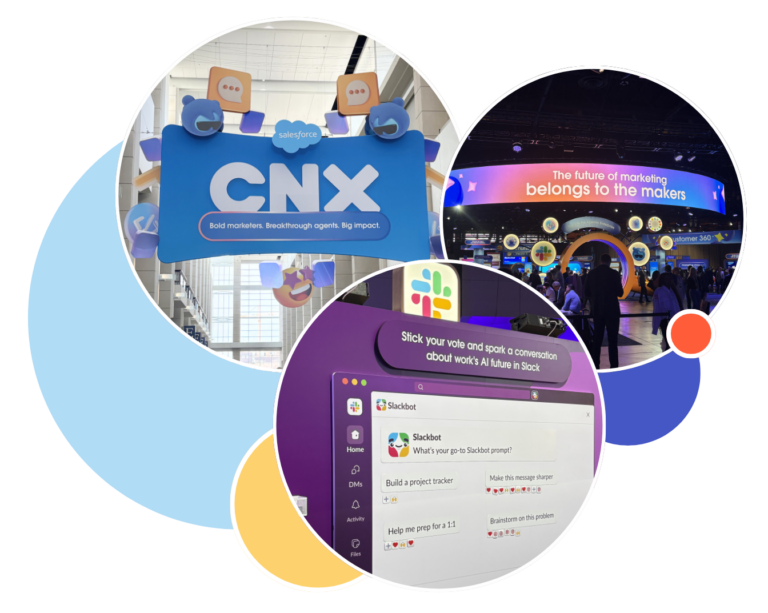
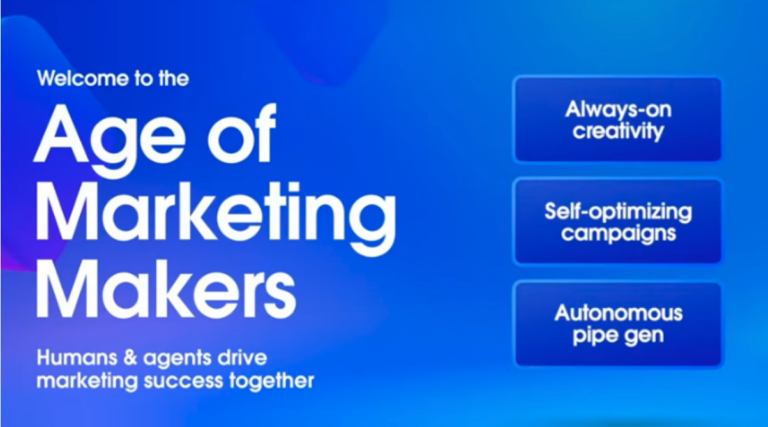
The big takeaway? Agentforce Marketing is the new foundation for “Marketing Makers,” giving time back to show up and do the work (us) marketers actually signed up for. It showed up everywhere: strategy, web engagement, sales, and even brand management.
The message was loud and clear: AI agents are evolving into functional team members, capable of collaborating directly with both internal staff and the customer base.
That shift creates both an opportunity and a responsibility.
As brands deploy more agents across digital touchpoints, marketers will increasingly be responsible for defining how those agents communicate, represent the brand, and move customers through the journey.
Agentforce Is Moving From Assistant to Coworker
Salesforce is doubling down on the idea that Agentforce is your new marketing coworker.
Traditional automation tools are great at executing predefined tasks. Agentforce is designed to understand business context, access CRM and marketing data, reason through objectives, and take action alongside marketers. The goal isn’t simply to automate work. It’s to help move work forward.
Throughout the conference, we saw examples of marketers using natural language to build campaigns, generate content, analyze performance, and align activities to business goals. It felt less like configuring software and more like collaborating with a teammate.
What stood out most, though, was how much more tangible the vision felt compared to previous years. We’ve heard plenty of promises about AI transforming marketing, sales, service, and operations. This was one of the first times the use cases felt practical, accessible, and close enough to imagine using tomorrow.
And that’s where the real opportunity lies.
The goal isn’t to replace marketers. It’s to eliminate the administrative work, context-switching, and repetitive tasks that often get in the way of strategy, creativity, and customer engagement.
Salesforce is also thinking beyond the boundaries of its own platform.
During Connections, it became increasingly clear that the long-term vision isn’t just about having an AI coworker inside Salesforce. It’s about bringing that coworker into the places where marketers already spend their time. Whether that’s Slack, collaboration tools, or other applications, the goal is to make Agentforce accessible without requiring users to constantly jump between systems.
That’s where Salesforce’s Headless 360 vision starts to get interesting for marketers. Historically, if you wanted to build a campaign, check performance, or manage a customer journey, you’d log into Marketing Cloud and work from there. Salesforce is now moving toward a model where many of those capabilities can be surfaced directly within the tools teams use every day.
While Slack was one of the most visible examples showcased, the bigger story is that customer data, business context, and AI-powered actions are no longer tied to a single interface.
Instead of opening an application to find information or complete a task, marketers can increasingly bring those capabilities into their existing workflows and conversations.
It’s a subtle shift, but an important one.
The future Salesforce is describing isn’t just smarter marketing software. It’s a world where intelligence is embedded wherever work happens, making it easier for teams to access insights, collaborate, and take action in the moment.
Taken together, it reinforces what became the overarching theme of Connections 2026: giving marketers more time to focus on the work that requires human judgment, creativity, and connection, while agents help handle the rest.
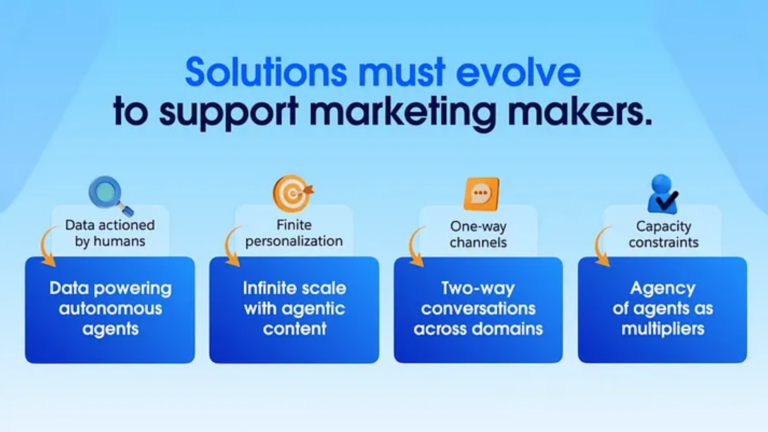
Every Customer Touchpoint Is Becoming Agent-Powered
One of the strongest messages from Day 2 was that marketers now define the experience across every agentic touchpoint.
Think beyond the website chatbot (but more on this in a bit).
Salesforce painted a picture of a customer journey increasingly supported by Sales Agents, Shopper Agents, Help Agents, Prospecting Agents, Event Agents, and third-party agents, all working together to engage customers in different contexts.
Our jobs are changing. We aren’t just managing campaigns anymore; we’re managing how these agents represent our brand in every single interaction.
This was reinforced through Salesforce’s emphasis on unified brand management and governance. The introduction of centralized brand assets and controls signals a recognition that as AI-generated content and interactions scale, maintaining consistency becomes even more important.
It’s about authenticity, even when it’s automated.
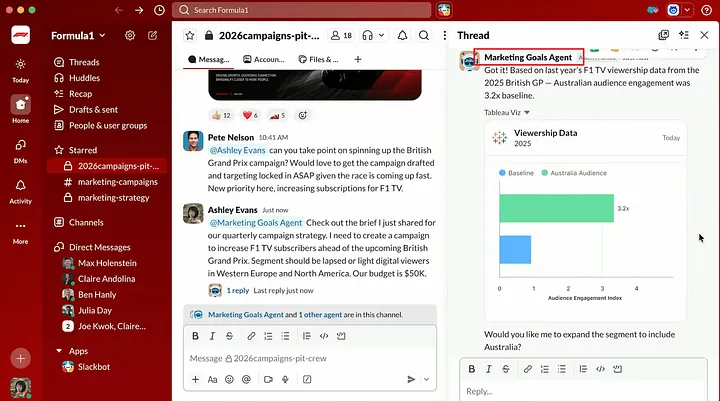
Goals Agent Signals a Shift Toward Outcome-Based Marketing
Keep an eye on the Agentforce Marketing Goals Agent. This is a big one.
Rather than focusing marketers on channels or tasks, Salesforce is pushing toward a goal-driven model where AI helps connect execution to business outcomes.
Whether the objective is pipeline generation, customer engagement, event attendance, or revenue growth, Goals Agent is designed to help marketers identify priorities, recommend actions, and orchestrate campaigns aligned to those objectives so that they actually move the needle.
It’s a subtle shift, but it’s huge. We’ve spent years optimizing “stuff.” Now we can optimize outcomes.
The Qualified Acquisition May Be One of the Most Exciting Announcements
While many AI conversations remain conceptual, the acquisition of Qualified and the introduction to a new SDR Agent, Piper, stood out because of its immediate business application. SDR Agents can engage website visitors, answer questions, qualify prospects, follow up through email, and route opportunities directly to sales teams.
For organizations with lean sales development resources, this could become one of the fastest paths to improving inbound conversion performance.
The use case is compelling because it focuses on one of the most valuable moments in the customer journey: intent.
If a visitor is browsing your website, they want answers fast. An SDR Agent acts as an immediate touchpoint, leveraging CRM insights to stay contextually relevant and converting that digital intent into active pipeline right then and there. The experience is further enhanced by built-in multilingual capabilities and natural voice interactions.
For many of us, this is the most practical use case for Agentforce Marketing out there today. See the demo here!
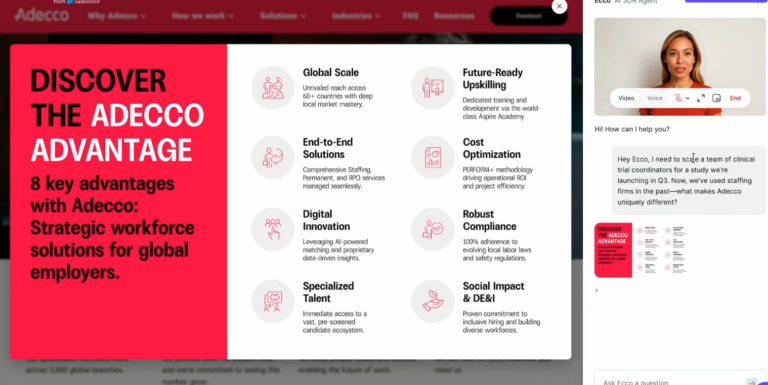
Whether someone is exploring a website, registering for an event, researching a solution, or engaging with an agent, the goal is increasingly to understand what they’re trying to accomplish and respond accordingly. The highest-performing experiences reduce friction, simplify navigation, and create opportunities for meaningful engagement at the moment interest is highest.
As agent-powered experiences become more common, marketers will need to think just as much about intent signals as they have been thinking about channels. The brands that win will be the ones that respond intelligently when customers are ready to take action. When someone shows interest, you need to be there.
Garbage In, Garbage Out: Data Still Matters
For all the excitement surrounding agentic marketing, Salesforce also delivered an important reminder (and very much what we’ve been echoing for some time now): none of this works without strong data foundations.
Data 360, audience segmentation, marketing intelligence, and unified customer profiles remained core components of the story. Agentforce may be the interface, but Data 360 remains the engine.
The better your data, the smarter your agent will be. It’s that simple.
So, before you go on an agentic deployment frenzy (or recommend this to your executive sponsors), make sure the data strategy is solid. Identity resolution and segmentation aren’t optional anymore.
Why the Agentforce Marketing Realignment Matters
Beyond the product announcements, Connections 2026 also signaled an important shift in Salesforce’s marketing strategy.
Last year’s event introduced Marketing Cloud Next as the future of Salesforce marketing technology. This year, however, Agentforce Marketing emerged as the primary narrative. While Marketing Cloud Next remains the product foundation, Agentforce Marketing is increasingly becoming the lens through which Salesforce is positioning its entire marketing ecosystem.
At first glance, this may seem like a branding exercise (because we’ll be honest, there’ve been quite a few product names thrown around in the last year referring to Salesforce’s Data Cloud-based marketing offerings). But we think it’s much more than that.
The shift reflects a broader evolution happening across the industry. Marketing platforms are no longer being evaluated solely on their ability to send emails, build journeys, or manage audiences. They’re being evaluated on their ability to help teams make decisions, automate actions, and engage customers through intelligent agents.
Here’s how the new setup looks:
Agentforce Marketing (Brand)
↓
Marketing Cloud Next (Product)
↓
Growth Edition / Advanced Edition (Editions)
Whether the discussion centered on campaign planning, content creation, customer engagement, SDR workflows, or website experiences, agents were positioned as the connective tissue between data, strategy, and execution.
For marketers, the takeaway isn’t that another product name has entered the Salesforce ecosystem. It’s that Salesforce is betting heavily on a future where agents become an extension of the marketing team.
The organizations that prepare for that shift now will be better positioned to take advantage of what’s coming next.
Some Final Thoughts
CNX’26 didn’t say AI is taking your job. It said AI is giving you a superpower.
We didn’t go through all of the use cases or tools in depth here, but we will in upcoming articles. Why? Because we love knowing more before we show and tell.
What we do know is that the organizations that succeed won’t be the ones with the most agents. They’ll be the ones that thoughtfully combine human creativity, strong brand strategy, and customer data with AI-powered execution.
It’s not us versus the bots. It’s us designing better worlds using them.
Whether you’re excited, skeptical, or somewhere in between, we’re always up for a conversation about how agentic marketing can create real business value, not just another shiny object. Curious where Agentforce Marketing fits into your roadmap? Let’s chat.
Let's chat!