
Most teams treat the decision to invest in a digital asset management (DAM) tool as a marketing operations question. A way to get organized, clean up the shared drive, and stop the designer from getting pinged fifteen times a day. And while those are real problems worth solving, they are not the reason a DAM pays off.
The teams that get the most out of a DAM treat it as a revenue infrastructure question. That shift changes what you buy, how you implement it, and whether your revenue team ever actually uses it. It also changes what success looks like once you are live.
Here is what that looks like in practice. A sales rep is mid-cycle on a deal and needs the latest product one-pager. They cannot find it in the shared drive, so they pull the deck they used three months ago. It has the old pricing. The campaign your marketing team spent two weeks building launches with an asset that was still in draft form because no one could track down the approved version in time. These are not isolated inconveniences. They are friction points in your go-to-market motion, and they compound over time. Sometimes it’s obvious; sometimes, not so much.
Ultimately, a DAM also serves as your primary defense against brand dilution. As AI-generated content continues to saturate the market, your competitive edge will come from the assets that remain authentic, accurate, and recognizable. By keeping your core materials under central control, you ensure that your brand cuts through the noise rather than getting lost in it.
What a DAM Actually Is (And What It Is Not)
It is worth being direct about this because the category name does not help itself.
Google Drive stores files. Dropbox stores files. A digital asset management tool does something different; it manages the lifecycle, accessibility, permissions, and context around your files. The distinction matters more than it sounds.
Anyone can create a folder structure. The problem is that folder structures don’t always scale. They do not tell you which version of an asset is approved, who has access to what (and when they were given access), when a file expires, or what rights you have to use it. They also do not give your external partners, agencies, or channel teams a clean, controlled portal without handing them access to everything else. A shared drive tries to solve internal and external asset management with one blunt instrument. It works until it does not, and by the time you notice it has stopped working, the problem is usually already widespread.
A DAM creates a single source of truth that is structured, searchable, and governed. Internal teams get version control and collaborative workflows. External partners get purpose-built portals with the right assets and the right permissions. The asset library stops being a filing problem and starts being an operational asset.
Why Marketing Teams Specifically Feel This First
The problem does not announce itself all at once. It builds gradually as the organization scales, and marketing teams tend to feel it first because they sit at the intersection of content production, distribution, and governance.
What is manageable for a small team of five becomes a liability at fifty. When more people need access to more assets across more campaigns, the informal systems that held things together start to break down. Someone updates a logo but forgets to replace it in every asset that lives across different folders. A sales rep builds their own leave-behind because they could not navigate the official library fast enough to find what they needed. Customer success sends a case study that was retired six months ago, because the technology recommendation has already evolved.
None of these feel like major failures in isolation. Collectively, they represent something more significant; inconsistent brand, compliance exposure, and a sales team that has quietly stopped trusting the materials their marketing team produces. That last one has a direct impact on deal cycles, and it rarely shows up anywhere on a dashboard.
Let’s Talk About AI
In the era of AI, the bar for brand visibility has shifted. AI allows for the rapid, mass-production of content, which paradoxically makes genuine brand differentiation more difficult. When everyone can produce infinite variations of “content,” the value of clean, distinct, and memorable assets skyrockets. A DAM is your safeguard here, ensuring that while AI may help you scale production, your core brand assets remain consistent, accurate, and recognizable. Without that central control, your brand risks being diluted by an ocean of generic, unvetted AI-generated material that muddies your market position.
How to Know If Your Organization Actually Needs One
The honest answer is that most organizations need a DAM before they realize they do. By the time the problem is obvious, the informal workarounds have already become deeply embedded in how teams operate.
A few questions worth sitting with honestly:
How much time does a new sales rep spend hunting for materials in their first 30 days? Onboarding friction is one of the most reliable signals that your asset management infrastructure is not keeping up with your team’s needs (even if it is internal).
How often does legal or brand have to chase down an expired or off-brand asset after it has already been used? If this happens more than once a month, this could be both a people problem and an infrastructure problem.
When a campaign goes out, how confident is the team that every asset in it is the approved version? If the answer involves a timely degree of manual checking or institutional knowledge, that confidence is fragile.
Beyond those questions, there is a tech readiness dimension worth being clear-eyed about. A DAM is not a plug-and-play tool. The question is not whether your organization has a tech stack; it is whether that stack has a logical integration point for a DAM to connect to, and whether your team has the operational maturity to govern it once it is live. Who owns the taxonomy? Who approves new assets? Who retires the old ones? These are decisions that need to be made before go-live, not after.
What Actually Changes When It Is Done Right
When a DAM is implemented with clear governance and connected to the workflows and systems your teams are already running, the impact is operational rather than cosmetic.
New rep ramp time shortens when approved materials are findable from day one, without a Slack message or a trip to the shared drive. Campaign deployment accelerates when assets are pre-approved and accessible without a re-approval cycle every time. Legal and compliance exposure drops when usage rights and asset expiry are managed systematically rather than manually tracked in a spreadsheet somewhere. And sales and marketing alignment improves; not because of a new process or a new meeting cadence, but because the shared infrastructure makes working from the same materials the path of least resistance.
That last point is worth underlining. The most durable form of alignment is the kind that does not require ongoing effort to maintain. When sales can pull approved, current collateral directly from the same system marketing uses to produce it, the gap between what marketing creates and what sales uses starts to close on its own.
Where It Usually Goes Wrong
This is the part most DAM articles skip, but it is probably the most useful thing we can share.
The most common failure mode is not a bad tool choice. It is a scoping problem. Teams decide to invest in a DAM, treat the implementation as a storage upgrade, and go live without connecting it to the workflows that sales and marketing are actually running. The result is a well-organized library that nobody outside the marketing team uses. Technically successful, operationally inert.
The second most common failure mode is launching without a governance model in place. A DAM without clear ownership of the taxonomy, asset approval process, and retirement workflow becomes disorganized at roughly the same rate as the shared drive it replaced. The tool does not solve the problem; the operating model does.
If you are in the process of choosing a DAM, focus your implementation strategy on establishing governance and defining high-value use cases, deciding exactly what content belongs in the system, before diving into feature-by-feature checklists.
Tools Worth Considering; A Salesforce-First Lens
The tool you choose matters less than how it connects to the rest of your revenue stack. For most of our clients, that means Salesforce is the integration that determines whether a DAM gets used by the revenue team or stays siloed within marketing.
When a DAM connects to your “source of truth” system, approved assets become accessible inside the workflows your sales and marketing teams are already running. A rep does not need to leave Salesforce to find the right one-pager. A marketing campaign can pull directly from a governed asset library without manual downloading and re-uploading. That is the difference between a tool with adoption and a tool with good intentions.
This is what that kind of integration looks like in practice. Bynder’s Salesforce DAM Connect, for example, pushes approved, brand-safe assets directly into Salesforce CMS, Marketing Cloud, and Experience Cloud. Reps and marketers can search, select, and insert approved assets directly into their existing Salesforce workflows without leaving the platform, and updates made in Bynder are reflected automatically wherever the asset is being used. Brandfolder takes a similar approach on the Sales Cloud side, giving reps a tab inside Salesforce where they can pull sell sheets, sales decks, and other brand assets directly into their workflow without leaving the CRM.
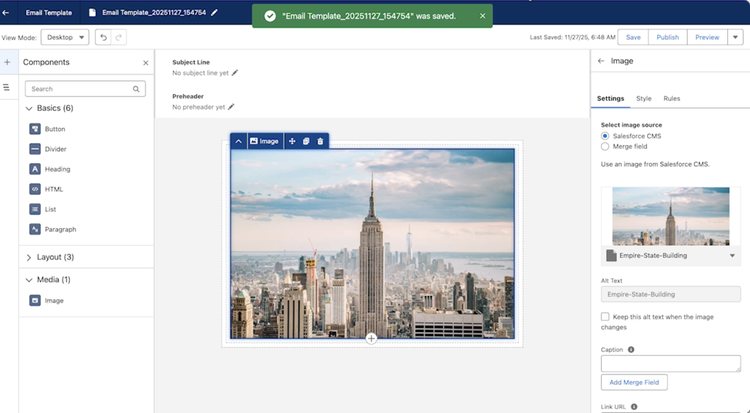
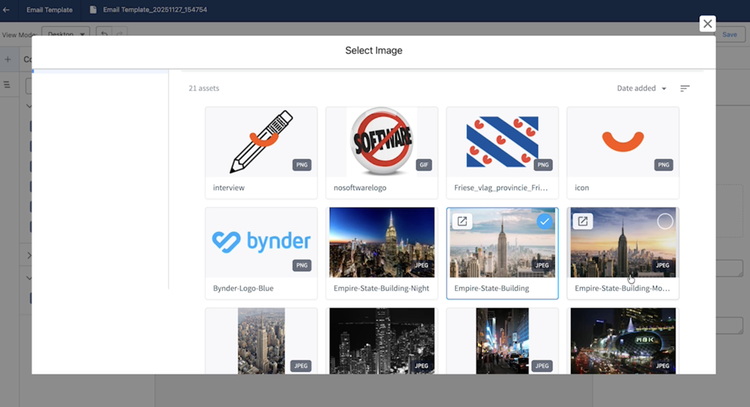
The other tools mentioned below offer similar Salesforce-native experiences; the specific workflow looks different depending on the platform, but the principle holds across all of them: the asset library should live inside the tools your revenue team already works in, not alongside them.
When evaluating your options, the questions worth asking are:
- How deep is the Salesforce CRM and Marketing Cloud integration, and does it create a live reference to the asset or just a static copy?
- How does the permission architecture handle both internal teams and external partners?
- How robust is the metadata and search capability for teams who did not create the assets they are looking for?
- How are external partner portals structured and governed?
Four tools consistently come up in this context for organizations working within the Salesforce ecosystem:
Bynder offers a DAM Connect integration co-developed with Salesforce that covers CMS Workspaces, Marketing Cloud, Experience Cloud, and B2B Commerce. Because the integration creates a live reference rather than a static copy, asset updates in Bynder flow through automatically to wherever the asset is in use.
Brandfolder has native integration with both Salesforce CRM and Marketing Cloud. Assets are accessible directly within Salesforce, and any updates made in Brandfolder are reflected automatically, so reps are always working with the current version without having to check.
Widen/Acquia DAM is an enterprise-grade option with confirmed Salesforce integration alongside Adobe Creative Cloud and other common stack tools. It is a strong fit for organizations managing high volumes of assets across multiple markets or product lines.
Canto offers a native Salesforce connector and tends to be a practical fit for mid-market teams that need solid functionality without a lengthy implementation runway.
The right choice depends on your stack, your team size, and the governance model you are building around the tool. Evaluate them against your own operational context rather than against each other on a feature matrix.
The Asset Layer Is Part of Your Revenue Infrastructure
A DAM is not just a marketing team’s organizational project. It is part of the infrastructure that determines how efficiently your GTM motion runs; how quickly campaigns get out the door, how consistently your brand shows up in front of buyers, and how confidently your sales team uses the materials your marketing team produces.
The organizations that treat it that way tend to get compounding returns over time. The ones that treat it as a storage upgrade usually underinvest in governance, underimplement the integration with their revenue stack, and find themselves back in the same place a year later with a more expensive version of the same problem.
If you are thinking through how a DAM fits into your marketing tech stack and what a well-governed implementation looks like for your team, that is exactly the kind of conversation we have with clients. Let’s chat.
Let's chat!